As the title of this blog may tell you, I am not in Sevilla right now, or even in Spain. Why, you ask? Well, Semana Santa is a very big deal in Sevilla-- every day is a holiday for everyone for more than a whole week. I have been looking forward to seeing Semana Santa in Sevilla since I started thinking about study abroad, but it is also a very long break and I wanted to take advantage of some of that time to do a bit of outside travelling. So, for the first few days of Semana Santa, I decided to travel to Ireland. I think I might just say that again because I am so excited: IRELAND! I will be gone for a little less than a week (Wednesday March 24 to Tuesday March 30), but will return with plenty of time to see most of Semana Santa in Sevilla (Tuesday to Sunday).
So, now that you know what I am doing, I guess I might tell you a little more about how it has been, or maybe just a few reflections and realizations.
1. There is nothing like independence to make you feel so free and so incredibly vulnerable at the same time. There is no one depending on me but myself; and at the same time, I am depending on no one but myself. That is to say, I can make all the plans I want and do the things I want to do when I want to do them, but !geeze louise! it is a lot of pressure and a lot of hard work. There is no one holding my hand or taking care of me, and if something goes wrong, it is no one's fault but my own. Sometimes the things we thought we wanted, although great and glorious, often remind us of the things we had before. As I am here in Ireland doing all these travel things for myself, I find myself missing having food cooked for me and a consistent bed and a real "home" to come home to. At the same time, I am finally doing something that I have wanted to do since I was a kid. What a mess I am, right?
2. (To follow 1) Adventure is out there! And Adventure is scary. That is why it is an adventure. But it is also glorious and exciting and new and surprising. That is also why it is adventure. So, here I am wanting Adventure (with a capital A) in the Great Wide Somewhere and realizing that I am scared stiff. How can what I want so badly scare me just as badly at the same time?
3. There are few feelings worse than realizing when it is already too late that you forgot your lunch on the kitchen counter. Believe me. It has happened to me multiple times, and it always makes the day a little less cheery than it might have been.
4. (To follow 3) There is always time to double check. To quote my wonderful dad: "Prevention is easier than fixing." I know this. Seriously, it has been drilled into my brain since childhood. So why on earth do I still forget my lunch on the kitchen counter?
Wednesday, March 24, 2010

Monday, March 22, 2010
Granada
I spent this past weekend exploring the streets and monuments of Granada with a group from my school. My roomate Christy has a friend, Tiffany, from her home university who is studying abroad in Grandada right now, so we were able to meet up with her. She came to visit Sevilla a few weeks ago, and we were able to show her around our city, and this weekend she was able to return the favor. Tiffany has actually been in Granada for a semester already, so she was able to show us the city in a different kind of way, taking us on a fantastic walking tour through the Albaicín (the old Arab neighborhood) and afterwards to her favorite tapas place. It was wonderful to see the city from the perspective of another student who had been living there and had discovered so many things about the city already-- like favorite places to walk to or favorite places to eat. Granada has a tradition that with the purchase of a drink (una copa) comes a free tapa; there may be copas without tapas, but never tapas without copas. One of the reasons I loved Granada is that it is one of those quirky cities with character, not just urban concrete and twisted freeways; maybe what I want to express is the difference I feel when walking the streets of a city like San Francisco compared to how I feel when driving through the skyscrapers of a city like Los Angeles. I think that is why I love San Diego (and now Sevilla) so much.
Well, now back to Granada: Granada is a city in the Sierra Nevada mountains of Andalucia where one can still see the influence that the Arabs had while they were in power during that period of Spanish history. (Sierra Nevada sound familiar? Well, sierra means mountain range and nevada means snowy, so now you know). The old Arab neighborhood, called the Albaicín (all-by-seen), is still a huge part of the city of Granada. (Most of my photos are of the Albaicín and the view from the top of a hill somewhere in the depths of the neighborhood).
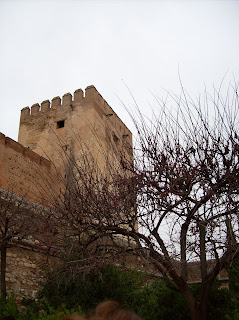
Granada was the last city that King Ferdinand and Queen Isabella (whom we call los Reyes Católicos or the Catholic Monarchs) recovered from the control of the Arabs during the Reconquest of Spain. They kept the Alhambra (the moorish citadel and palace) as a symbol of the power of their reign; the Arabs had, after all, been there for centuries and now Granada, their last bastion of power, had been conquered by the Catholic Monarchs. I do not know how I feel about the religious-political propoganda of the Catholic Monarchs, but I am glad that they did not destroy the Alhambra because it is magnificent. I think I might like the Alcázar of Sevilla better, but the Alhambra and its gardens were beautiful.
Anyway, because Granada was such an important city to the Catholic Monarchs, they asked to be buried there, and for that purpose they commisioned la Capilla Real (the Royal Chapel). It was amazing to see with my own eyes what I have been learning about in my classes. I am taking History/Civilization of Spain (1500 to present) as well as Art History of Spain (1500 to present) and it has been so fun for me as everyhting comes together. Basically, I get to study the history of Spain as well as the art that came out of Spain during that history all at the same time. This means that when we visited la Capilla Real, I understood it's history and why it was in Granada, what period and artistic styles it is a product of, why the building itself is in mainly a gothic style but the monuments are in the style of the Renaissance, and so much more. I was able to enjoy the visit on a deeper level than I would have if I had simply visited it with a tour guide who mentioned a few of the facts as we passed through. Next to the Alhambra is the palace of Carlos V, which we also studied in my Art History class. I cannot communicate how the pictures on the slide show do not do it justice and how lucky I feel to be able to see these great works in person while I am studying them.
One last thing: The pomegranate (in Spanish granada) is the symbol of Granada (claro). It appears on the flag, public transportation, sidewalks, and all kinds of city property-- very much like the motto and symbol of Sevilla, NO8DO, which I will explain another time.
(This is me leaving you in suspense, waiting to read my next blog... I don't know if it is working...)


Monday, March 15, 2010
¿Una Moto? Ok, whatever you say.
In addition to the upper-division Spanish program CC-CS has for American college students, they also hold English classes in the Center and offer English tutoring for Spanish children. As I am studying to be a teacher, have had experience with children and with tutoring, and would love to have some extra cash, I decided to sign up to be a tutor through the program. Because it had been a while and I had not heard anything, I assumed that I was not going to receive any students to tutor. However, when I checked my email today, I had a message saying that I did indeed have students and the parents would like me to start today.
I nervously proceeded to call the phone number given to me and to talk with Ignacio, the father of the two children whom I will be working with. After we determined that 3:30 to 4:30 in the afternoon on Mondays and Wednesdays would work the best for everyone, he asked that I meet him in front of the Corte Ingles in Nervion so he could walk with me to their house so I did not get lost. "Ok. I can do that," I thought. "No pasa nada." This, however, required that I rush home immediately after my class ended aty 1:45 pm, eat quickly (which never exactly works out in Spain because meals always have a way of taking longer than you think), and leave my house at 3:00 pm to power-walk to El Corte Ingles by 3:30 pm. No pasa nada, right?
Well, Carmen was out when I arrived home; because everything happened so quickly while I was at school, I did not have a chance to tell her that I was in a hurry for lunch today. After I was eventually able to gulp down some lunch and run out the door, I made it to our meeting place in time. Except I was the only one who was on time. I waited there for about twenty minutes before I received a call from Teresa, the mother of the family, apologizing for the confusion and saying that Ignacio was coming to get me "en la moto" because it was a little before 4:00 pm and they did not want me to be late for my class at 5:00 pm. As I was too busy being relieved that they had not forgotten me and wondering about how on earth I was going to get to class, it did not quite register in my brain that "la moto" is short for "la motocicleta." ......
Ignacio showed up a few minutes later, sure enough on a moto scooter. As he explained that he had been caught up at work and apologized for being late, he pulled out a spare helmet and handed it to me. To his question of "¿Te da miedo las motos?" (Are you afraid of motos?), I replied, "No, no. Está bien," even though that was not exactly the truth. He assured me that we would go slowly anyway. I put on the helmet, got on the back of the scooter, put my feet on the small foot rests, and then we were off-- in the direction from which I had come! I had just power-walked twenty minutes down Calle San Francisco y Javier to get there on time, and now we were riding back in the direction I came from. I could do nothing but smile (trying not to laugh). There I was in Sevilla, with the wind in my face, riding on the back of a scooter with someone I had just met. The situation was, well, just ironically funny, but here in Sevilla-- with a wave of the hand and "No pasa nada," we just go with it.
We got to the house, and I met Teresa and los niños-- Nacho, the boy, is 12 and his sister Teresita is 10. We did a few exercises and talked for while, so I could get to know them a little and get a feel for how much English they knew, but we did not have enough time for a full hour. Ignacio told me that he would take me back to school on the moto today so that I would not be late, for which I was very grateful. I strapped on the spare helmet again-- a little tighter this time so it did not slip to the back of my head in the wind-- and we were off once again. To get back to the Center, we drove along the river (which was very scenic from my view on the back of a moto) and through some back streets to avoid traffic before pulling up in front of the Center on Calle Harinas. I thanked Ignacio for getting me there on time for class and said good-bye, thinking to myself, "Well, that was interesting."
¿Una moto? Ok, whatever you say. No pasa nada.
I nervously proceeded to call the phone number given to me and to talk with Ignacio, the father of the two children whom I will be working with. After we determined that 3:30 to 4:30 in the afternoon on Mondays and Wednesdays would work the best for everyone, he asked that I meet him in front of the Corte Ingles in Nervion so he could walk with me to their house so I did not get lost. "Ok. I can do that," I thought. "No pasa nada." This, however, required that I rush home immediately after my class ended aty 1:45 pm, eat quickly (which never exactly works out in Spain because meals always have a way of taking longer than you think), and leave my house at 3:00 pm to power-walk to El Corte Ingles by 3:30 pm. No pasa nada, right?
Well, Carmen was out when I arrived home; because everything happened so quickly while I was at school, I did not have a chance to tell her that I was in a hurry for lunch today. After I was eventually able to gulp down some lunch and run out the door, I made it to our meeting place in time. Except I was the only one who was on time. I waited there for about twenty minutes before I received a call from Teresa, the mother of the family, apologizing for the confusion and saying that Ignacio was coming to get me "en la moto" because it was a little before 4:00 pm and they did not want me to be late for my class at 5:00 pm. As I was too busy being relieved that they had not forgotten me and wondering about how on earth I was going to get to class, it did not quite register in my brain that "la moto" is short for "la motocicleta." ......
Ignacio showed up a few minutes later, sure enough on a moto scooter. As he explained that he had been caught up at work and apologized for being late, he pulled out a spare helmet and handed it to me. To his question of "¿Te da miedo las motos?" (Are you afraid of motos?), I replied, "No, no. Está bien," even though that was not exactly the truth. He assured me that we would go slowly anyway. I put on the helmet, got on the back of the scooter, put my feet on the small foot rests, and then we were off-- in the direction from which I had come! I had just power-walked twenty minutes down Calle San Francisco y Javier to get there on time, and now we were riding back in the direction I came from. I could do nothing but smile (trying not to laugh). There I was in Sevilla, with the wind in my face, riding on the back of a scooter with someone I had just met. The situation was, well, just ironically funny, but here in Sevilla-- with a wave of the hand and "No pasa nada," we just go with it.
We got to the house, and I met Teresa and los niños-- Nacho, the boy, is 12 and his sister Teresita is 10. We did a few exercises and talked for while, so I could get to know them a little and get a feel for how much English they knew, but we did not have enough time for a full hour. Ignacio told me that he would take me back to school on the moto today so that I would not be late, for which I was very grateful. I strapped on the spare helmet again-- a little tighter this time so it did not slip to the back of my head in the wind-- and we were off once again. To get back to the Center, we drove along the river (which was very scenic from my view on the back of a moto) and through some back streets to avoid traffic before pulling up in front of the Center on Calle Harinas. I thanked Ignacio for getting me there on time for class and said good-bye, thinking to myself, "Well, that was interesting."
¿Una moto? Ok, whatever you say. No pasa nada.
Wednesday, March 10, 2010
An Artsy Semester
So, I am now in the middle of my second week of regular classes (my first month here was an intensive period of just one language class every day for four hours) and I have sorted out my schedule. I am taking Advanced Spanish Composition, History/Civilization of Spain, Art History of Spain, Spanish Film, and Cultural Realities of Spain. As most of you know, I am majoring in Literature and Spanish at Point Loma, and I was hoping to be able to study literature of Spain while I am in Spain, but it was impossible due to schedule conflicts. On the other hand, I am tremendously excited about how well all of my classes fit together this semester. My Spanish Civ. class and my Art History class are both starting with the fifteenth century and moving forward to the modern era. Studying both the history of Spain and the art of Spain that came out of those eras in the same semester is going to be fantastic. It is also going to be a really artsy semester for me with Art History, Spanish Film, and a water-color painting class I am taking for fun on top of my normal hobby of photography. It should be interesting, and I am looking forward to learning a lot, to say the least.
Monday, March 8, 2010
A Soundtrack for Life
I ride the bus from Nervion every morning to Prado San Sebastián where I transfer to the tramvía (electric/cable train) to continue on to Plaza Nueva where I get off and walk a few more blocks to school. I then do this in reverse to go home for lunch, then come back to school for my classes in the afternoon, and then once again in reverse when my day is finally done. Needless to say, I spend a lot of time on public transportation (when it finally stops raining here, I hope to walk more, but until then...well, we continue on). The tramvía at least is always tuned to what must be a classical radio station-- sometimes it is an intense symphony, a melancholy piano sonata, or famous operatic works. Although I already had a sense of how important music is in a film, I am learning more about it in my Spanish Film class, which, consequently, is changing the way I observe and perceive things. When riding the tramvía, I find myself imagining that the music is part of the soundtrack of my life or someone else's life: "If this were a movie, what kind of emotions should I be feeling, what kind of thoughts would be going through my head, where would I be headed, and where would I be coming from?" Oh, man, my profe would be so proud.
Friday, March 5, 2010
A Passionate Language
One of the things I love about the Spanish language is the passionate and descriptive nature of it. I have heard some names that in Spanish are perfectly normal, but would be quite strange in English. One of my professor’s names is Milagros (Miracles) but she goes by Mila, and another of my professor’s names is Consolación (Consolation) but she shortens it to Conso. Encarna (one of the women I met in my apartment complex) is short for Encarnación (Incarnation – like the theological term) and my friend Jess was telling me that she met a woman named Puri, which is short for Purificación (Purification). I doubt you would find those names in a book like 1001 Baby Names in the States. One can get away with saying fantastic things in Spanish that would never fly in English. For example, this past week I bought books and school supplies for my classes, and when I paid in exact change, the girl behind the counter said, “Gracias. Stupendo.” Now, as someone who has worked behind a counter, I can get away with saying “Awesome, thanks,” but if I said “Stupendous,” you would probably wonder what I had been drinking lately. In the same way, phrases like “Chicos, es divino!” (Guys, it is divine!) and “Que barbaridad!” (What a barbarity!) that are normal in Spanish evoke sentiments of, shall we say… “Drama-Queen” ? … in English. Seriously, if I started saying things like “What a barbarity!” or if you heard other people saying, “People, this is just divine!” what would you do?
Wednesday, March 3, 2010
Morocco
This past weekend I visited Morocco with a tourist group based here in Sevilla. Almost all the students from my program went on this trip to Morocco as well as other study-abroad students here in Spain. It was strange returning to Africa with a huge tourist group, actually rather unsettling. I think I experienced more culture shock from that huge group of tourists than I have experienced anywhere else, even when I went to Africa the first time. We visited a few cities in Morocco—Chef Chaouen, Tangiers, Tetuan, Ceuta—but only the very touristy parts. Don’t misunderstand me—the cities were beautiful, I learned a lot about the culture and customs, and I am very glad I went. I just hate being a tourist, especially in a place like Africa where it is crucial to be culturally sensitive and aware of the issues there. I hate being with a group of tourists, especially a huge group of tourists who are so blatantly American. Well, enough of that. Morocco is officially a Muslim country, but I was surprised at how many changes have occurred within the past decade for the Moroccans. The government of Morocco is an absolute monarchy (the king has all the power), and their current king is relatively young, about forty-five or so. He was educated abroad somewhere and has put into effect what to me appear to be some very good changes in the country. For example, the current king’s wedding was a public one, which means that for the first time in the history of Morocco, the people have seen the face of their queen; in the past, the wife (or wives) of the king were always veiled and never seen by the people. She also appears to be involved in several causes and active in her role as queen, which to me seems to be a wonderful step forward for the rights of women in Muslim countries. I hope that the government of Morocco as a Muslim country can set an example for other more conservative Muslim countries in the world to take steps for women’s rights. Besides some of those political things, I learned a little bit about the Muslim culture itself. One of my favorite moments was walking the windy streets of Chef Chaouen, a beautiful small market town (yes, Mom, I was in a big group, which consequently made us even more obvious). I asked our guide, a local man of about sixty, why everything was painted in shades of blue, and he told me that certain colors are very significant in the Muslim culture. For example, blue represents the love of Allah, white represents the peace of Islam, and green represents the community of Muslims around the world. This explains a lot; every Islamic center I have ever seen in the States has been painted in schemes of white and blue or green, and now that I understand the symbolism, it makes a lot of sense.


Subscribe to:
Comments (Atom)