Showing posts with label Reflections. Show all posts
Showing posts with label Reflections. Show all posts
Friday, June 4, 2010
Home
So I am back in California, home from my adventure in Spain. And I miss Spain already. California, forgive me; I did not realize how much I loved you until I was away. But, culture shock on re-entry is much worse than it was going into Spain. It is crazy to think about all that has happened and how much I have changed in the past few months. Even though I am no longer in Spain, there is so much I am still thinking about and still processing. So, even though I will not be posting things that are currently happening, I think I will continue writing about memories from Spain and everything I am still working through.

Sunday, May 16, 2010
Where did the time go?
It is my last week in Spain... I don't know what to say or think. I don't know if I am ready or not. It seems to change by the minute.
Part of me says, "It's time. It's time to go home." This is the part of me that wants to see my family and friends, misses the ocean and the beach, and wants In'N'Out Burger and a chocolate shake like none other.
Part of me says, "There is so much still to do and see-- there wasn't enough time and I am not ready to say good-bye." This is the part of me that is sad about not having travelled to all the places I wanted to, not having tried all the things I wanted to, and also the part of me that is not ready to say good-bye to all my friends here.
One thing I do know: I am definitely ready to be finished with school and finals. I am just ready for summer and the freedom I am (possibly falsely) convinced will come with it. Sometime during the last week, School and Spain morphed into one entity, so although I am maybe not ready to say good-bye to Spain and all that I love here, I am ready to be home for summer.
In the meantime, I am studying for finals and trying to pack up my whole life into one suitcase, which happens to be quite difficult...
Part of me says, "It's time. It's time to go home." This is the part of me that wants to see my family and friends, misses the ocean and the beach, and wants In'N'Out Burger and a chocolate shake like none other.
Part of me says, "There is so much still to do and see-- there wasn't enough time and I am not ready to say good-bye." This is the part of me that is sad about not having travelled to all the places I wanted to, not having tried all the things I wanted to, and also the part of me that is not ready to say good-bye to all my friends here.
One thing I do know: I am definitely ready to be finished with school and finals. I am just ready for summer and the freedom I am (possibly falsely) convinced will come with it. Sometime during the last week, School and Spain morphed into one entity, so although I am maybe not ready to say good-bye to Spain and all that I love here, I am ready to be home for summer.
In the meantime, I am studying for finals and trying to pack up my whole life into one suitcase, which happens to be quite difficult...
Thursday, May 6, 2010
Some of the reasons why Spain has stolen my heart
For the past week or so temporary stands and booths have been being constructed in Plaza Nueva and in Plaza de San Francisco. I discovered first that, in addition to celebrating the Day of the Book on April 23, today begins the Sevilla Feria del Libro--a ten day festival celebrating the book. When I was in Barcelona, I discovered that they celebrate el día de San Jordi (Sait George in English-- you know the guy who killed the dragon) which also happens to be April 23; it is like their Valentine's day, except they exchange books and flowers. Anyway, the booths in Plaza Nueva and Plaza de San Francisco are filled with books from the bookstores around Sevilla. If you did not already realize, this is Lit Major Heaven, and I need not say that this could be very dangerous for my wallet. (Sevilla, you have a city-wide book fair!? Do you know how much I love you?)
This is not the only way in which Spain has stolen my heart. In Barcelona I visited the Chocolate Museum, or the Museu de Xocolata as it is known in Catalan. Besides the fact that sweet chocolate was a Spanish invention (the Spanish took the bitter chocolate used by the Aztecs and mixed it with milk and sugar which was the beginning of what we know as chocolate), the first mechanized chocolate factory was in Barcelona, Spain. Many of the displays are chocolate sculptures, including various well-known Barcelona buildings and illustrations from various stories. It is owned by the Gremi de Pastisseria de Barcelona (the city pastry-makers' guild) and on the other side of teh courtyard is the school for pastry chefs. The wall of the building is practically all windows, so I stood there watching them bake for a long time. It was like the Food Network, only better.
This is not the only way in which Spain has stolen my heart. In Barcelona I visited the Chocolate Museum, or the Museu de Xocolata as it is known in Catalan. Besides the fact that sweet chocolate was a Spanish invention (the Spanish took the bitter chocolate used by the Aztecs and mixed it with milk and sugar which was the beginning of what we know as chocolate), the first mechanized chocolate factory was in Barcelona, Spain. Many of the displays are chocolate sculptures, including various well-known Barcelona buildings and illustrations from various stories. It is owned by the Gremi de Pastisseria de Barcelona (the city pastry-makers' guild) and on the other side of teh courtyard is the school for pastry chefs. The wall of the building is practically all windows, so I stood there watching them bake for a long time. It was like the Food Network, only better.
Monday, May 3, 2010
Toro! Toro! OLE!
I finally mustered up the courage to go to a bull fight (corrida de toros) this past Sunday. I convinced myself that it was a cultural nessecity and that my experience in Spain would be incomplete without it. How could I tell people that I lived in Spain and never went to a Corrida de Toros? So, I found a few other friends who felt the same way and we decided to go to a Novelladas (a Corrida with younger toreros and younger bulls, basically like the "minor leagues," if you will). And I actually enjoyed it. If you know me, you know how I feel about blood and gore and what I have just said may have come as a shock. However, it was not as bloody as I thought it would be and I actually found it really interesting. And besides thinking of Ferdinand (a book from my childhood) through the whole thing, I had a little Hemmingway moment-- forgive me for being a Lit nerd.
The Corrida de Toros, practiced in Spain, Portugal, some cities in southern France as well as in several Lain American countries, is a traditional spectacle where bulls are ritually killed in a public arena. Spain, above all, is known for tauromachy (bullfighting), and I was a little surprised to hear about the other countries that still practice the sport. Bullfighting is said to have been a tradition that sprang up in the colonies of the Roman Empire in Western Europe (i.e.: what is now Spain and Portugal) where many human-versus-animal events were held. There are also theories that it first cane to Spain by way of Emperor Claudius as a substitute for gladiatiors when he instituted a short-lived ban on gladiatorial combat. Bullfighting later spread from Spain to its Central and South American colonies, and in the 19th century to France.
The tradition of the Corrida de Toros as it is practiced today involves professional toreros (bull fighters) who execute various formal, even artistic, moves in order to maneuver, subdue, and eventually kill the bull. These maneuvers are performed with little protection and at very close range. Obviously, it is dangerous and can end in injury or death of the torero; but it is important to remember that he has chosen this profession (this is, in fact, his job) and is professionally trained. The subject of toros is one of strong debate in Spain becuase of the danger for the torero and because certain groups feel that it is a blood sport and useless killing or propogates animal cruelty. It is also important to remenber that every toro used in a Corrida is treated exceptionally well and that after the bull is killed, all of it is used for meat. In addition to being a delicacy of Spain, it is supposedly the best quality of meat there is becauseof how well it is fed and how well it is treated (although I have never tried it). Aficionados say that the Corrida de Toros is the ultimate union of art and courage. Bulls learn fast and their capacity to do so should never be underestimated. Indeed, a bullfight may be viewed as a race against time for the matador, who must display his bullfighting skills with style and with proper form before the animal learns what is going on thrusts its horns at something other than the cape.
Anyway, back to the actual bullfight.
There are two "rounds" and three toreros (bull fighters) who, in total, each kill two bulls. They each kill one in the first round and each kill another in the second round. Even though they are all from the same year (imagine "grade") of bull-fighting school, they start with the oldest then move to the youngest. During the Corrida the crowd alternates between clapping (which means good job, well done, we like it) and whistleing (which means bad job, poorly done, we don't like it). The crowd is critiquing the torero on his bravery, his performace, his style, and his artistic interpretation. The audience looks for the matador to display an appropriate level of style and courage and for the bull to display aggression and determination. For the matador, this means performing skillfully in front of the bull, often pushing the limits in how close he stands to the bull and turning his back on it to demonstrate his mastery over the animal. The skill with which he delivers the fatal blow is another major point to look for. A skillful matador will achieve it in one stroke that goes through the spinal chord of the bulla nd the aorta killing it instantly. Two tries is barely acceptable, while more than two is usually regarded as a bad job. The moment when the matador kills the bull is the most dangerous point of the entire fight, as it requires him to reach between the horns, head on, to deliver the blow. If a torero does really, really well, at the end of the fight the crowd will wave white pañuelos (kind of like handkercheifs) and one of the officials will cut off one of the ears (orejas) of the bull and give it to the torero as a trophy. Very, very rarely, the crowd may petition to spare the bull's life if it is exceptionally strong and brave. They did not give any orejas at the bull fight I went to, but I have seen it happen on TV. Carmen, my host mom, watches bull fights broadcasted live from Madrid. That's Spain for you.
One really interesting thing happened during the middle of the Corrida. The third torero had started to do his thing when the bull ran straight into one of the walls of the Plaza and tripped over it's horns that had gotten stuck in the ground. It must have injured it's neck or something in the fall, because after that it was really sluggish and was apparantly not fit for the fight. The crowd started whistling and whistling and all of a sudden everyone left the arena-- the picadores, banderilleros, and the toreros. The bull, deemed not suited to the fight, was left standing in the middle of the Plaza and after a few minutes about eight to ten steers (castrated bulls) entered the ring and roamed around the bull in the middle. The bull eventually calmed down and left teh ring with the steers. The steers are used to calm the bull down and get it out of the ring safely. The best thing about this is that I knew what was going on thanks to Ernest Hemmingway and his book The Sun Also Rises. And you thought a Literature Major was useless!
A parting thought:
Ernest Hemingway said of bullfighting in his 1932 non-fiction book Death in the Afternoon: "Bullfighting is the only art in which the artist is in danger of death and in which the degree of brilliance in the performance is left to the fighter's honour."
The Corrida de Toros, practiced in Spain, Portugal, some cities in southern France as well as in several Lain American countries, is a traditional spectacle where bulls are ritually killed in a public arena. Spain, above all, is known for tauromachy (bullfighting), and I was a little surprised to hear about the other countries that still practice the sport. Bullfighting is said to have been a tradition that sprang up in the colonies of the Roman Empire in Western Europe (i.e.: what is now Spain and Portugal) where many human-versus-animal events were held. There are also theories that it first cane to Spain by way of Emperor Claudius as a substitute for gladiatiors when he instituted a short-lived ban on gladiatorial combat. Bullfighting later spread from Spain to its Central and South American colonies, and in the 19th century to France.
The tradition of the Corrida de Toros as it is practiced today involves professional toreros (bull fighters) who execute various formal, even artistic, moves in order to maneuver, subdue, and eventually kill the bull. These maneuvers are performed with little protection and at very close range. Obviously, it is dangerous and can end in injury or death of the torero; but it is important to remember that he has chosen this profession (this is, in fact, his job) and is professionally trained. The subject of toros is one of strong debate in Spain becuase of the danger for the torero and because certain groups feel that it is a blood sport and useless killing or propogates animal cruelty. It is also important to remenber that every toro used in a Corrida is treated exceptionally well and that after the bull is killed, all of it is used for meat. In addition to being a delicacy of Spain, it is supposedly the best quality of meat there is becauseof how well it is fed and how well it is treated (although I have never tried it). Aficionados say that the Corrida de Toros is the ultimate union of art and courage. Bulls learn fast and their capacity to do so should never be underestimated. Indeed, a bullfight may be viewed as a race against time for the matador, who must display his bullfighting skills with style and with proper form before the animal learns what is going on thrusts its horns at something other than the cape.
Anyway, back to the actual bullfight.
There are two "rounds" and three toreros (bull fighters) who, in total, each kill two bulls. They each kill one in the first round and each kill another in the second round. Even though they are all from the same year (imagine "grade") of bull-fighting school, they start with the oldest then move to the youngest. During the Corrida the crowd alternates between clapping (which means good job, well done, we like it) and whistleing (which means bad job, poorly done, we don't like it). The crowd is critiquing the torero on his bravery, his performace, his style, and his artistic interpretation. The audience looks for the matador to display an appropriate level of style and courage and for the bull to display aggression and determination. For the matador, this means performing skillfully in front of the bull, often pushing the limits in how close he stands to the bull and turning his back on it to demonstrate his mastery over the animal. The skill with which he delivers the fatal blow is another major point to look for. A skillful matador will achieve it in one stroke that goes through the spinal chord of the bulla nd the aorta killing it instantly. Two tries is barely acceptable, while more than two is usually regarded as a bad job. The moment when the matador kills the bull is the most dangerous point of the entire fight, as it requires him to reach between the horns, head on, to deliver the blow. If a torero does really, really well, at the end of the fight the crowd will wave white pañuelos (kind of like handkercheifs) and one of the officials will cut off one of the ears (orejas) of the bull and give it to the torero as a trophy. Very, very rarely, the crowd may petition to spare the bull's life if it is exceptionally strong and brave. They did not give any orejas at the bull fight I went to, but I have seen it happen on TV. Carmen, my host mom, watches bull fights broadcasted live from Madrid. That's Spain for you.
One really interesting thing happened during the middle of the Corrida. The third torero had started to do his thing when the bull ran straight into one of the walls of the Plaza and tripped over it's horns that had gotten stuck in the ground. It must have injured it's neck or something in the fall, because after that it was really sluggish and was apparantly not fit for the fight. The crowd started whistling and whistling and all of a sudden everyone left the arena-- the picadores, banderilleros, and the toreros. The bull, deemed not suited to the fight, was left standing in the middle of the Plaza and after a few minutes about eight to ten steers (castrated bulls) entered the ring and roamed around the bull in the middle. The bull eventually calmed down and left teh ring with the steers. The steers are used to calm the bull down and get it out of the ring safely. The best thing about this is that I knew what was going on thanks to Ernest Hemmingway and his book The Sun Also Rises. And you thought a Literature Major was useless!
A parting thought:
Ernest Hemingway said of bullfighting in his 1932 non-fiction book Death in the Afternoon: "Bullfighting is the only art in which the artist is in danger of death and in which the degree of brilliance in the performance is left to the fighter's honour."
Saturday, May 1, 2010
Churches and Convents
The weather here in Sevilla has been like full summer in California with brilliant sun and slight humidity, but a heat that is sweetened by a light breeze every so often. I went for a walk this morning with three other girls to take advantage of the lovely weather and the quiet streets. For Christmas, my parents gave me a guidebook of Sevilla full of self-guided neighborhood walks and special walking tours of the city. It has seriously been one of the best and most useful gifts I have ever received; I have used it countless times and learned so much about the city and the history that is hidden on every corner.
Today we did a tour of churches and convents in the area of Sevilla known as La Macarena (which has absolutely nothing to do with Ricky Martin). We first passed by Iglesia del Salvador, a beautiful church that used to be the city’s main cathedral before the actual cathedral was built. Iglesia del Salvador was redone in later years, and now is now one of the most impressive baroque churches in the city—in terms of both architecture on the outside and art on the inside. Next stop was Iglesia de San Pedro, another baroque church that although much simpler than el Salvador, is still very beautiful. One of the tile paintings depicting purgatory on the outside of Iglesia de San Pedro has a small bird hidden in it (which I found); according to local legend, if you find the bird, it means you will get married...
Well, anyway, we moved on to the Monasterio de Santa Ines, a lovely small convent full of cloister nuns (meaning they have no contact with the outside world). Many of the convents in Sevilla (and I imagine in the rest of Spain and Europe too) don’t get as steady a stream of support as they did in past centuries, so they have to find other ways to support themselves. Many of them make jams, pastries, and other sweets to sell and sometimes rosaries and other crafts as well. However, it is difficult to sell things when you are a cloister nun and are shut off from the outside world, so they have developed an ingenious system. There is a small alcove with a rotating shelf in the wall where, after you ring the bell, a nun from behind the wall will ask you what you want. You then put the money on the shelf and she will turn the shelf around, take the money, put the pastries on her side of the shelf, and turn it back around so you can take them. I bought some tortas de chocolate, which turned out to be small chocolate biscuit/shortbread type cookies. Christy bought some magdalenas, which are kind of like the Spanish version of a muffin.
We went on to see a few more churches—Iglesia de San Marcos, Convento de Santa Isabel, and Palacio de las Dueñas—but my favorite was the Convento de Santa Paula, which is one of the few enclosed religious complexes in Sevilla that welcomes visitors. We went inside and talked to a nun who was adorable and lovely. She asked us about where we were from and how long we had been in Sevilla. She called us guapa and complimented me on my Spanish. I wish you could see how big I smiled. The nuns there make jam and marmalade, and we each bought some before leaving. Buying sweets and jam from nuns is like the epitome of fair trade—you buy all-natural products (made with love and prayer, nonetheless) and the money goes directly to good deeds and social justice without any intermediary. I think things might taste better when they are made by nuns.
In any case, it was a very lovely day.
Today we did a tour of churches and convents in the area of Sevilla known as La Macarena (which has absolutely nothing to do with Ricky Martin). We first passed by Iglesia del Salvador, a beautiful church that used to be the city’s main cathedral before the actual cathedral was built. Iglesia del Salvador was redone in later years, and now is now one of the most impressive baroque churches in the city—in terms of both architecture on the outside and art on the inside. Next stop was Iglesia de San Pedro, another baroque church that although much simpler than el Salvador, is still very beautiful. One of the tile paintings depicting purgatory on the outside of Iglesia de San Pedro has a small bird hidden in it (which I found); according to local legend, if you find the bird, it means you will get married...
Well, anyway, we moved on to the Monasterio de Santa Ines, a lovely small convent full of cloister nuns (meaning they have no contact with the outside world). Many of the convents in Sevilla (and I imagine in the rest of Spain and Europe too) don’t get as steady a stream of support as they did in past centuries, so they have to find other ways to support themselves. Many of them make jams, pastries, and other sweets to sell and sometimes rosaries and other crafts as well. However, it is difficult to sell things when you are a cloister nun and are shut off from the outside world, so they have developed an ingenious system. There is a small alcove with a rotating shelf in the wall where, after you ring the bell, a nun from behind the wall will ask you what you want. You then put the money on the shelf and she will turn the shelf around, take the money, put the pastries on her side of the shelf, and turn it back around so you can take them. I bought some tortas de chocolate, which turned out to be small chocolate biscuit/shortbread type cookies. Christy bought some magdalenas, which are kind of like the Spanish version of a muffin.
We went on to see a few more churches—Iglesia de San Marcos, Convento de Santa Isabel, and Palacio de las Dueñas—but my favorite was the Convento de Santa Paula, which is one of the few enclosed religious complexes in Sevilla that welcomes visitors. We went inside and talked to a nun who was adorable and lovely. She asked us about where we were from and how long we had been in Sevilla. She called us guapa and complimented me on my Spanish. I wish you could see how big I smiled. The nuns there make jam and marmalade, and we each bought some before leaving. Buying sweets and jam from nuns is like the epitome of fair trade—you buy all-natural products (made with love and prayer, nonetheless) and the money goes directly to good deeds and social justice without any intermediary. I think things might taste better when they are made by nuns.
In any case, it was a very lovely day.
Wednesday, April 21, 2010
Madrid: A Weekend of Art
This past weekend, I travelled to Madrid with my Art History class to see some of the larger museums in Spain. We went to the Prado (home of several very important works including Velazquez and El Greco), the Museo Reina Sofia (contemporary art from the 20th century and onward including Dali and Picasso), and the Museo Thyssen (everything). In addition to the art museums, we went to the Palacio Real (Royal Palace), the Plaza Mayor, and other parts of historic Madrid. In a small section of free time, I made a literary pilgrimage to the houses of Lope de Vega (a baroque playwright) and Cervantes (author of Don Quixote). (Laugh at me if you like.)
Although I was rather overwhelmed by its scope, I enjoyed the Prado very much. Seeing the paintings of El Greco in real life is an experience so completely different from seeing them on a PowerPoint slideshow. The Museo Reina Sofia was interesting, but the art of Spain from the 20th century is usually dark and depressing. Having been produced in ages dominated by war, dictators, censorship, disillusionment and general suffering, you can imagine that this art does not often deal with uplifting themes. The Museo Thyssen was my favorite because it had everything from gothic art to contemporary art in a museum that was a manageable size. In addition to several very interesting paintings that captured my attention, there was a special exhibit of Monet that I particularly enjoyed. It is one of those experiences where you arrive and realize that this something is much larger, more important, and perhaps more moving and powerful than you thought it was or even had imagined it to be.
Thursday, April 8, 2010
Teatro de la Maestranza
Last night, my roommate Christy and I went to the Teatro de la Maestranza, a famous modern theater here in Sevilla, to see the English National Ballet’s production of Cinderella. I have a list of things I need to do before leaving Sevilla, and one of the things on the list is to see something in the Teatro de la Maestranza. Christy and I noticed signs for the ballet on the street during Semana Santa, and after Christy told me that we could get tickets for only 26 euro, we decided to go for it. I am so glad that we did. Amazing. The music, by Russian composer Sergei Prokofiev, was beautiful beyond words. The grace with which the dancers moved seemed contagious, as if I gained grace and peace simply by watching them.
Pablo Picasso said, “Art washes away from the soul the dust of everyday life,” and it is so true. This has been a crazy week for me with projects due and a big exam yesterday. I have been trying to get things sorted out for next year at Point Loma, mainly housing and class registration. Without wasting your time with too many of the details of my problems with scheduling classes for next year, I will simply say that it has been a mess and so have I. I have been emailing just about every professor in my department trying to get things worked out, and yesterday I received an email that eliminated an option I had been counting on. I was crushed and at the end of my rope. Seeing the ballet after all of the stress and emotional exhaustion of this week was tangibly refreshing, even cleansing. And this weekend I am going to Madrid with my Art class to see some museums, so I am looking forward to a weekend of art.
Pablo Picasso said, “Art washes away from the soul the dust of everyday life,” and it is so true. This has been a crazy week for me with projects due and a big exam yesterday. I have been trying to get things sorted out for next year at Point Loma, mainly housing and class registration. Without wasting your time with too many of the details of my problems with scheduling classes for next year, I will simply say that it has been a mess and so have I. I have been emailing just about every professor in my department trying to get things worked out, and yesterday I received an email that eliminated an option I had been counting on. I was crushed and at the end of my rope. Seeing the ballet after all of the stress and emotional exhaustion of this week was tangibly refreshing, even cleansing. And this weekend I am going to Madrid with my Art class to see some museums, so I am looking forward to a weekend of art.
Saturday, April 3, 2010
Farewell to Semana Santa
Today, the last day of Semana Santa, we went out to see more pasos, to get some churros, and to say farewell to Semana Santa. I knew Semana Santa would be a big deal here in Sevilla and I was so excited that I would be able to be in Sevilla to celebrate Semana Santa where it is so famous, but I do not really know what I expected it to actually be like. It is an interesting concept—religious parades all day every day for a whole week. If we have debates about Nativity Scenes or the Ten Commandments being displayed in public places, I cannot imagine something like Semana Santa happening in the States. Here in Sevilla, everyone goes to mass during Semana Santa and is in the streets watching the pasos. Although they might not be practicing Catholics during the rest of the year, for Semana Santa, at least, everyone is Catholic. It was interesting to be a part of a festival that has such a strong religious theme but is much more cultural and not exactly religious at all anymore. For example, there are normally a lot of street performers in el Centro because it is a rather touristy area and they can get the attention (and money) that they want, but during Semana Santa the streets were full of every street performer I have ever seen there, plus new ones, all to make the most of the crowds of people. There were people selling balloons and there were stands selling popcorn, cotton candy, and silly toy horns and things—all stuff I would expect at something like the Strawberry Festival that happens in my home town or something similar, but not at what I perceived as a serious religious festival. There are people, like my señora Carmen, for whom Semana Santa holds deep religious significance, but largely it seems that people are there for the show, not because it is part of their faith or religious expression. I have really enjoyed Semana Santa, and I hope you maybe learned something new or at least enjoyed some of the stories I have had to tell. Thanks for reading and Happy Easter.
Monday, March 29, 2010
Pubs
I want to set some things straight. I realize that I have told a lot of stories from Ireland that involve pubs, and I want to be clear that the pubs of Ireland are not like bars in the States. (Disclaimer: I don’t even really know what bars in the States are like, so these comparisons are based off of my rather primitive and non-firsthand understanding of the bar culture of home). The pub is the center of Irish social life; the best thing I can compare it to is the coffee shop of the States. The whole community goes to the local pub for food, conversation, and live music, not just for a drink. It is a place where people hang out and talk, where the bartender knows your name and, more than that, is your neighbor. I met so many wonderful people, got a lot of free cups of tea, heard some great music, and all in all fell in love with the atmosphere of pubs and wish that back home in the States it were more like this.
The bars in Spain are also very different from what I understand the bars in the States to be like. When I was in Granada, we met up with a friend and she took us out to eat at her favorite tapas place, which was obviously a bar because every place that serves tapas (or any food, really) is a bar. But this was not like any bar I had ever seen (or heard of) in the States. We sat at the tables in the front left section of the bar, with the bar itself along the front right; but in the back section of the bar, there were couches set up around two or three coffee tables and some bookshelves along the wall with books, magazines, a checkers board, and some other games. There were two families sitting on the couches, the parents talking over a bottle of wine and children playing checkers and entertaining themselves. It was something you would expect to see in someone’s home, not in a public bar, but that is the way (some of) the bars of Spain are. There is a park near my apartment with a small outdoor bar/café, and it is perfectly normal to see parents sipping a glass of wine while their kids climb on the jungle gym and swing on the swing-set. It is just a very different cultural attitude towards alcohol and a different atmosphere as a result. Alcohol is an important part of the culture and a part of everyday life in a wholesome kind of way that is different from the States. Not that it is better or that I want bars opening in public parks at home, but I do think that the US might have less alcohol-related problems if alcohol were something people learned how appreciate socially and to enjoy in moderation from a young age. I also don’t want to say that all bars in Spain are like that—of course there are clubs and things, but as a general observation, the attitude towards alcohol and the consumption of alcohol is very different here in Spain and in Ireland as well. Something to think about and talk about (especially in view of Point Loma’s Covenant)…
The bars in Spain are also very different from what I understand the bars in the States to be like. When I was in Granada, we met up with a friend and she took us out to eat at her favorite tapas place, which was obviously a bar because every place that serves tapas (or any food, really) is a bar. But this was not like any bar I had ever seen (or heard of) in the States. We sat at the tables in the front left section of the bar, with the bar itself along the front right; but in the back section of the bar, there were couches set up around two or three coffee tables and some bookshelves along the wall with books, magazines, a checkers board, and some other games. There were two families sitting on the couches, the parents talking over a bottle of wine and children playing checkers and entertaining themselves. It was something you would expect to see in someone’s home, not in a public bar, but that is the way (some of) the bars of Spain are. There is a park near my apartment with a small outdoor bar/café, and it is perfectly normal to see parents sipping a glass of wine while their kids climb on the jungle gym and swing on the swing-set. It is just a very different cultural attitude towards alcohol and a different atmosphere as a result. Alcohol is an important part of the culture and a part of everyday life in a wholesome kind of way that is different from the States. Not that it is better or that I want bars opening in public parks at home, but I do think that the US might have less alcohol-related problems if alcohol were something people learned how appreciate socially and to enjoy in moderation from a young age. I also don’t want to say that all bars in Spain are like that—of course there are clubs and things, but as a general observation, the attitude towards alcohol and the consumption of alcohol is very different here in Spain and in Ireland as well. Something to think about and talk about (especially in view of Point Loma’s Covenant)…
Friday, March 26, 2010
More Lessons from a Pub
I love the pubs of Ireland. I love the good food, the tea, the music, and just community that they are. I like trying new things, especially new food-- it is a kind of miniature adventure in itself. One thing I have been doing for some meals here in Ireland is getting recommendations from locals about favorite local pubs and ordering the daily "special." Now that has been an adventure. Forrest Gump's momma always said, "Life is like a box of chocolates. You never know what you're going to get." That is a lie; well, maybe just an inaccurate comparison. I can tell you exactly what you will get in a box of chocolates: CHOCOLATE. Now, the pub's daily "special" on the other hand... who knows. In spite of the uncertainty that clouds the "special," I have been continually pleasantly surprised. I have ordered the soup and sandwich specials at a few different pubs, and each time (although some things sounded quite bizarre) I absolutely loved it. Especially the roll with glazed pork, bread crumbs and applesauce alongside a bowl of potato and mushroom soup. Strange, yes? But amazingly delicious. So, my new and improved analogy: Life is like the neighborhood pub's daily special-- you never know what you are going to get, but you will might just find yourself pleasantly surprised.
Thursday, March 25, 2010
Lessons from a Pub (first night in Dublin)
As I had just arrived in Dublin after a very long and rather stressful day of travelling, I did not feel up to a too-large dose of adventure right away. I took some time to settle in to the hostel and use the computer for a bit before asking the man at the reception desk if there was a place close by that he would recommend for dinner and maybe some live music. He was very friendly and told me Brannigan's Pub right around the corner for food and The Celt a little further away for music. I thanked him and headed to Brannigan's pub, hoping to find something cheap to eat and maybe just sit and listen to Irish accents. I was not disappointed.
The pub was a typical local pub, which I love, with good food, a relaxed atmosphere, a friendly bartender, and friendly people. I walked up to the bar and ordered some food, just in time to catch the start of the football match which I pretended to be deeply interested in and made a little bit of small talk about it with the man sitting a few seats down the bar. I enjoyed the quiet time, just listening and thinking. After I finished my food, the man who I had only casually talked to introduced himself as Gary and started talking to me as I sipped my cup of Irish tea (or scald as it is sometimes called here). He must have wanted someone to talk to (or maybe it was the Guinness), because we talked (well, he mostly talked and I mostly listened) for more than two hours and it was one of the greatest things of my life. He asked me where I was from and just started telling me stories about his life and teling me about Dublin. All in all, he bought me two cups of tea and two 7UPs as we talked about politics, religion, travelling, literature, football, and family (to name just a few) and he was full of the most amazing stories and bits of wisdom.
One of my favorites was: "I like to take the ideas of how you are supposed to be, what you're supposed to look like, what you are supposed to do and turn 'em on their heads... Then I like to bang 'em on their heads a few times for good measure." And when he was talking about Irish stew: "As an Irishman, I know a good spud. This one was stunning." He told me he was curious about where I was from because my accent was very slight; after we started talking more he said I sounded more American, but at least I was able to blend in for a while. As we were finishing up, he said "You're a watcher, you are. Keep on watching and paying attention and you won't be dissappointed. You have a good gaze-- a good hold. There must be a hell of a lot of Irish in you." When I said that there was, he laughed with the pleasure of being right and told me he could tell, that my facial features, dark hair, and light eyes are very Irish-- what they call Black Irish, descended from the original Celts (the red hair you may think of as traditional Irish comes from the Viking bloodlines). He said, "You're a good girl, you are. Just trying to find your way, and doing it Sweeney Todd, too-- that just means alone, you know. You're doing the right thing and you're doing all right." Thanks for the encouragement, Gary.
The pub was a typical local pub, which I love, with good food, a relaxed atmosphere, a friendly bartender, and friendly people. I walked up to the bar and ordered some food, just in time to catch the start of the football match which I pretended to be deeply interested in and made a little bit of small talk about it with the man sitting a few seats down the bar. I enjoyed the quiet time, just listening and thinking. After I finished my food, the man who I had only casually talked to introduced himself as Gary and started talking to me as I sipped my cup of Irish tea (or scald as it is sometimes called here). He must have wanted someone to talk to (or maybe it was the Guinness), because we talked (well, he mostly talked and I mostly listened) for more than two hours and it was one of the greatest things of my life. He asked me where I was from and just started telling me stories about his life and teling me about Dublin. All in all, he bought me two cups of tea and two 7UPs as we talked about politics, religion, travelling, literature, football, and family (to name just a few) and he was full of the most amazing stories and bits of wisdom.
One of my favorites was: "I like to take the ideas of how you are supposed to be, what you're supposed to look like, what you are supposed to do and turn 'em on their heads... Then I like to bang 'em on their heads a few times for good measure." And when he was talking about Irish stew: "As an Irishman, I know a good spud. This one was stunning." He told me he was curious about where I was from because my accent was very slight; after we started talking more he said I sounded more American, but at least I was able to blend in for a while. As we were finishing up, he said "You're a watcher, you are. Keep on watching and paying attention and you won't be dissappointed. You have a good gaze-- a good hold. There must be a hell of a lot of Irish in you." When I said that there was, he laughed with the pleasure of being right and told me he could tell, that my facial features, dark hair, and light eyes are very Irish-- what they call Black Irish, descended from the original Celts (the red hair you may think of as traditional Irish comes from the Viking bloodlines). He said, "You're a good girl, you are. Just trying to find your way, and doing it Sweeney Todd, too-- that just means alone, you know. You're doing the right thing and you're doing all right." Thanks for the encouragement, Gary.
Wednesday, March 24, 2010
On the Streets of Dublin
As the title of this blog may tell you, I am not in Sevilla right now, or even in Spain. Why, you ask? Well, Semana Santa is a very big deal in Sevilla-- every day is a holiday for everyone for more than a whole week. I have been looking forward to seeing Semana Santa in Sevilla since I started thinking about study abroad, but it is also a very long break and I wanted to take advantage of some of that time to do a bit of outside travelling. So, for the first few days of Semana Santa, I decided to travel to Ireland. I think I might just say that again because I am so excited: IRELAND! I will be gone for a little less than a week (Wednesday March 24 to Tuesday March 30), but will return with plenty of time to see most of Semana Santa in Sevilla (Tuesday to Sunday).
So, now that you know what I am doing, I guess I might tell you a little more about how it has been, or maybe just a few reflections and realizations.
1. There is nothing like independence to make you feel so free and so incredibly vulnerable at the same time. There is no one depending on me but myself; and at the same time, I am depending on no one but myself. That is to say, I can make all the plans I want and do the things I want to do when I want to do them, but !geeze louise! it is a lot of pressure and a lot of hard work. There is no one holding my hand or taking care of me, and if something goes wrong, it is no one's fault but my own. Sometimes the things we thought we wanted, although great and glorious, often remind us of the things we had before. As I am here in Ireland doing all these travel things for myself, I find myself missing having food cooked for me and a consistent bed and a real "home" to come home to. At the same time, I am finally doing something that I have wanted to do since I was a kid. What a mess I am, right?
2. (To follow 1) Adventure is out there! And Adventure is scary. That is why it is an adventure. But it is also glorious and exciting and new and surprising. That is also why it is adventure. So, here I am wanting Adventure (with a capital A) in the Great Wide Somewhere and realizing that I am scared stiff. How can what I want so badly scare me just as badly at the same time?
3. There are few feelings worse than realizing when it is already too late that you forgot your lunch on the kitchen counter. Believe me. It has happened to me multiple times, and it always makes the day a little less cheery than it might have been.
4. (To follow 3) There is always time to double check. To quote my wonderful dad: "Prevention is easier than fixing." I know this. Seriously, it has been drilled into my brain since childhood. So why on earth do I still forget my lunch on the kitchen counter?
So, now that you know what I am doing, I guess I might tell you a little more about how it has been, or maybe just a few reflections and realizations.
1. There is nothing like independence to make you feel so free and so incredibly vulnerable at the same time. There is no one depending on me but myself; and at the same time, I am depending on no one but myself. That is to say, I can make all the plans I want and do the things I want to do when I want to do them, but !geeze louise! it is a lot of pressure and a lot of hard work. There is no one holding my hand or taking care of me, and if something goes wrong, it is no one's fault but my own. Sometimes the things we thought we wanted, although great and glorious, often remind us of the things we had before. As I am here in Ireland doing all these travel things for myself, I find myself missing having food cooked for me and a consistent bed and a real "home" to come home to. At the same time, I am finally doing something that I have wanted to do since I was a kid. What a mess I am, right?
2. (To follow 1) Adventure is out there! And Adventure is scary. That is why it is an adventure. But it is also glorious and exciting and new and surprising. That is also why it is adventure. So, here I am wanting Adventure (with a capital A) in the Great Wide Somewhere and realizing that I am scared stiff. How can what I want so badly scare me just as badly at the same time?
3. There are few feelings worse than realizing when it is already too late that you forgot your lunch on the kitchen counter. Believe me. It has happened to me multiple times, and it always makes the day a little less cheery than it might have been.
4. (To follow 3) There is always time to double check. To quote my wonderful dad: "Prevention is easier than fixing." I know this. Seriously, it has been drilled into my brain since childhood. So why on earth do I still forget my lunch on the kitchen counter?
Monday, March 22, 2010
Granada
I spent this past weekend exploring the streets and monuments of Granada with a group from my school. My roomate Christy has a friend, Tiffany, from her home university who is studying abroad in Grandada right now, so we were able to meet up with her. She came to visit Sevilla a few weeks ago, and we were able to show her around our city, and this weekend she was able to return the favor. Tiffany has actually been in Granada for a semester already, so she was able to show us the city in a different kind of way, taking us on a fantastic walking tour through the Albaicín (the old Arab neighborhood) and afterwards to her favorite tapas place. It was wonderful to see the city from the perspective of another student who had been living there and had discovered so many things about the city already-- like favorite places to walk to or favorite places to eat. Granada has a tradition that with the purchase of a drink (una copa) comes a free tapa; there may be copas without tapas, but never tapas without copas. One of the reasons I loved Granada is that it is one of those quirky cities with character, not just urban concrete and twisted freeways; maybe what I want to express is the difference I feel when walking the streets of a city like San Francisco compared to how I feel when driving through the skyscrapers of a city like Los Angeles. I think that is why I love San Diego (and now Sevilla) so much.
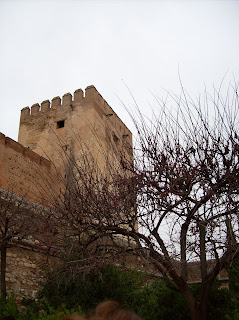
Well, now back to Granada: Granada is a city in the Sierra Nevada mountains of Andalucia where one can still see the influence that the Arabs had while they were in power during that period of Spanish history. (Sierra Nevada sound familiar? Well, sierra means mountain range and nevada means snowy, so now you know). The old Arab neighborhood, called the Albaicín (all-by-seen), is still a huge part of the city of Granada. (Most of my photos are of the Albaicín and the view from the top of a hill somewhere in the depths of the neighborhood).
Granada was the last city that King Ferdinand and Queen Isabella (whom we call los Reyes Católicos or the Catholic Monarchs) recovered from the control of the Arabs during the Reconquest of Spain. They kept the Alhambra (the moorish citadel and palace) as a symbol of the power of their reign; the Arabs had, after all, been there for centuries and now Granada, their last bastion of power, had been conquered by the Catholic Monarchs. I do not know how I feel about the religious-political propoganda of the Catholic Monarchs, but I am glad that they did not destroy the Alhambra because it is magnificent. I think I might like the Alcázar of Sevilla better, but the Alhambra and its gardens were beautiful.
Anyway, because Granada was such an important city to the Catholic Monarchs, they asked to be buried there, and for that purpose they commisioned la Capilla Real (the Royal Chapel). It was amazing to see with my own eyes what I have been learning about in my classes. I am taking History/Civilization of Spain (1500 to present) as well as Art History of Spain (1500 to present) and it has been so fun for me as everyhting comes together. Basically, I get to study the history of Spain as well as the art that came out of Spain during that history all at the same time. This means that when we visited la Capilla Real, I understood it's history and why it was in Granada, what period and artistic styles it is a product of, why the building itself is in mainly a gothic style but the monuments are in the style of the Renaissance, and so much more. I was able to enjoy the visit on a deeper level than I would have if I had simply visited it with a tour guide who mentioned a few of the facts as we passed through. Next to the Alhambra is the palace of Carlos V, which we also studied in my Art History class. I cannot communicate how the pictures on the slide show do not do it justice and how lucky I feel to be able to see these great works in person while I am studying them.
One last thing: The pomegranate (in Spanish granada) is the symbol of Granada (claro). It appears on the flag, public transportation, sidewalks, and all kinds of city property-- very much like the motto and symbol of Sevilla, NO8DO, which I will explain another time.
(This is me leaving you in suspense, waiting to read my next blog... I don't know if it is working...)


Wednesday, March 3, 2010
Morocco
This past weekend I visited Morocco with a tourist group based here in Sevilla. Almost all the students from my program went on this trip to Morocco as well as other study-abroad students here in Spain. It was strange returning to Africa with a huge tourist group, actually rather unsettling. I think I experienced more culture shock from that huge group of tourists than I have experienced anywhere else, even when I went to Africa the first time. We visited a few cities in Morocco—Chef Chaouen, Tangiers, Tetuan, Ceuta—but only the very touristy parts. Don’t misunderstand me—the cities were beautiful, I learned a lot about the culture and customs, and I am very glad I went. I just hate being a tourist, especially in a place like Africa where it is crucial to be culturally sensitive and aware of the issues there. I hate being with a group of tourists, especially a huge group of tourists who are so blatantly American. Well, enough of that. Morocco is officially a Muslim country, but I was surprised at how many changes have occurred within the past decade for the Moroccans. The government of Morocco is an absolute monarchy (the king has all the power), and their current king is relatively young, about forty-five or so. He was educated abroad somewhere and has put into effect what to me appear to be some very good changes in the country. For example, the current king’s wedding was a public one, which means that for the first time in the history of Morocco, the people have seen the face of their queen; in the past, the wife (or wives) of the king were always veiled and never seen by the people. She also appears to be involved in several causes and active in her role as queen, which to me seems to be a wonderful step forward for the rights of women in Muslim countries. I hope that the government of Morocco as a Muslim country can set an example for other more conservative Muslim countries in the world to take steps for women’s rights. Besides some of those political things, I learned a little bit about the Muslim culture itself. One of my favorite moments was walking the windy streets of Chef Chaouen, a beautiful small market town (yes, Mom, I was in a big group, which consequently made us even more obvious). I asked our guide, a local man of about sixty, why everything was painted in shades of blue, and he told me that certain colors are very significant in the Muslim culture. For example, blue represents the love of Allah, white represents the peace of Islam, and green represents the community of Muslims around the world. This explains a lot; every Islamic center I have ever seen in the States has been painted in schemes of white and blue or green, and now that I understand the symbolism, it makes a lot of sense.


Friday, February 26, 2010
Reflections from Itálica


Yesterday, on another fieldtrip, I went to the ruins of Itálica a few miles outside the city of Sevilla. The ancient Roman city of Itálica was built in 206 BC by a Roman general and his troops in order to protect Roman soldiers wounded after a battle. According to my profe, every soldier in the Roman army carried a few posts along with their normal gear so that if they needed to they could construct a fort quickly, which is what they did for Itálica. Obviously, they later built a real city complete with an amphitheater that seated 25,000 spectators (the third largest in the Roman Empire). It was rainy and gloomy when we were there, but as my friend Christy said, it seemed rather fitting. The rain lent a touch of antiquity and even tragedy to the place. It seems very right that it should rain while one is walking around ruins, almost as if no other atmosphere or ambiance would make sense. Standing in the middle of the amphitheater was intimidating and sobering; I could imagine it filled with people, imagine how much blood was spilled on that ground. I felt very small standing in a place that was so ancient, so other-worldly, as if my life has been nothing but an infinitesimal speck in the great span of the centuries, which, of course, it has. I found myself imagining the city at the time of Christ, imagining what that world may have been like, and thinking about the sacrificial death of Jesus Christ and the martyrs. We are in the season of Lent right now (the forty days prior to Easter), which is a season of contemplation of the death of Christ; it is a season of sorrow, but also of anticipation of the coming Resurrection. In the middle of a ruined Roman city, I was reminded that though I am small, a mere speck from the perspective of time and the universe, Christ died for me so that I may have new life which is more significant by far than any empire. And although this city was once great, perhaps even significant from the perspective of history, it is now in ruins. In a small way, I was reminded of the things in life that are truly significant, the things that will last forever, and they are not grand empires or impressive cities, but instead they are the things of the Kingdom of God. Eventually the season of my life will come to an end, like all things do, and I do not know if I will be great or significant like the Roman empire, but I do know that if I am remembered, it will not be for the sake of my own life or works, but because for some inexplicable reason God chose to work through me.
Monday, February 1, 2010
This is it!
I just finished zipping up my suitcase a few minutes ago and it hit me that I am actually leaving for Spain tomorrow. It seems as if I have been anticipating and planning my semester abroad for ages, and it has been hard to wrap my mind around the fact that it is actually happening—finally and definitively happening.
"Tomorrow. I am leaving tomorrow," I keep telling myself.
Packing has been a nightmare... I have never been good at it, and trying to fit my life into one suitcase was challenging to say the least. I have been bogged down in the details of packing and flying and just getting things ready, and all I really want is to be there already.
"Tomorrow. I am leaving tomorrow," I keep telling myself.
Although I am so excited to be finally going, I am realizing how much I will miss everyone. Megan, my best friend, gave me a going-away present last night: a stack of letters she had written for me, one for each week plus a few extras to tide me over until I see her again.
"Tomorrow. I am leaving tomorrow," I keep telling myself. This is my last good-bye.
Wednesday, December 23, 2009

Tuesday, December 15, 2009
Good-byes
"Parting is such sweet sorrow" ~Shakespeare
It is Finals week, the last week of the semester, and I have been packing up and preparing to move out in a few days. I've just realized that I won't be back here to Point Loma for a very long time. I guess I have been looking forward to going to Spain for so long that I was only ever excited about it. I still am very excited to be going, but until now I had not thought about how hard it would be to say good-bye.
During this week I have been saying good-bye to a lot of people. Quite a few of my friends are graduating this year, and I have no idea where they will be and what they will be doing when I come back from Spain. I don't know when I will see some of them again. Those who are not graduating will be here when I return in the Fall, but that is still a long time to be away.
These good-byes make everything feel so final, so official. I really don't like saying good-bye. But I hate NOT saying good-bye even more, so here I am bidding my friends farewell as we all frantically study for our final exams and try to get those last papers turned in.
It is Finals week, the last week of the semester, and I have been packing up and preparing to move out in a few days. I've just realized that I won't be back here to Point Loma for a very long time. I guess I have been looking forward to going to Spain for so long that I was only ever excited about it. I still am very excited to be going, but until now I had not thought about how hard it would be to say good-bye.
During this week I have been saying good-bye to a lot of people. Quite a few of my friends are graduating this year, and I have no idea where they will be and what they will be doing when I come back from Spain. I don't know when I will see some of them again. Those who are not graduating will be here when I return in the Fall, but that is still a long time to be away.
These good-byes make everything feel so final, so official. I really don't like saying good-bye. But I hate NOT saying good-bye even more, so here I am bidding my friends farewell as we all frantically study for our final exams and try to get those last papers turned in.
Wednesday, December 9, 2009
A Note of Explanation
Perhaps a note of explanation is in order-- about who I am, what I am doing here, and where I hope to be going.
In the past I have thought about starting a blog where I might share thoughts and experiences, where I might simply write about the epiphanies (great and small) of my life, but I think that those thoughts were only half serious. I don't know if I ever actually meant to do anything with them... But here I am, pushed into the public realm (well, only if people actually read this) by this great adventure before me.
Oh, yeah. I am going to be living in Spain for a semester, studying abroad at the Universidad de Sevilla.
Other languages and cultures have always fascinated me, especially the Spanish language, which is one of the reasons that I decided to add a Spanish Major at PLNU (I actually have two majors-- Literature/English Education is the other one). Because immersion is the best way to learn a language and understand a culture, I decided to study abroad in a Spanish-speaking country to improve my Spanish skills, to better understand the Spanish culture and world I live in, as well as to become a more well-rounded person.
I looked through countless study abroad pamphlets and a mountain of booklets until I finally found what I was looking for in the Center for Cross-Cultural Study. I was looking for a challenging academic environment where I would be able to improve my Spanish language skills, but I also wanted to study in a place where I could live with a native family in order to truly understand the culture and build relationships. I found that CC-CS provided both a stimulating academic environment as wells as the opportunity to live with a family, and, ultimately, I chose their program in Seville, Spain.
I believe that studying abroad will help me better understand not only Spanish culture, but also the world I live in as a whole. After living abroad, travelling, and experiencing different cultures, I will be able to become a more globally minded citizen and will be better able to function in our growing global economy. It is so important to me to be able to see the world and experience it first hand, and I am looking forward to understanding and participating in the customs and culture of Spain.
I know that I will grow so much through this experience, and I am deeply grateful that CC-CS values diversity and has an emphasis on personal growth. I am so excited to be living with and becoming a part of a Spanish family. I hope that I will be able to get involved with the community in Seville, Spain and make lasting friendships during my time there. Living in such beautiful city, rich in Flamenco culture and Moorish architecture, will be very exciting, and I am looking forward to the adventure that next semester will be, but I won't pretend that I am not a little nervous as well... So, this is a place where I can share about my experiences-- from triumphs to failures-- during my semester abroad.
That's all for now. Thanks for reading,
In the past I have thought about starting a blog where I might share thoughts and experiences, where I might simply write about the epiphanies (great and small) of my life, but I think that those thoughts were only half serious. I don't know if I ever actually meant to do anything with them... But here I am, pushed into the public realm (well, only if people actually read this) by this great adventure before me.
Oh, yeah. I am going to be living in Spain for a semester, studying abroad at the Universidad de Sevilla.
Other languages and cultures have always fascinated me, especially the Spanish language, which is one of the reasons that I decided to add a Spanish Major at PLNU (I actually have two majors-- Literature/English Education is the other one). Because immersion is the best way to learn a language and understand a culture, I decided to study abroad in a Spanish-speaking country to improve my Spanish skills, to better understand the Spanish culture and world I live in, as well as to become a more well-rounded person.
I looked through countless study abroad pamphlets and a mountain of booklets until I finally found what I was looking for in the Center for Cross-Cultural Study. I was looking for a challenging academic environment where I would be able to improve my Spanish language skills, but I also wanted to study in a place where I could live with a native family in order to truly understand the culture and build relationships. I found that CC-CS provided both a stimulating academic environment as wells as the opportunity to live with a family, and, ultimately, I chose their program in Seville, Spain.
I believe that studying abroad will help me better understand not only Spanish culture, but also the world I live in as a whole. After living abroad, travelling, and experiencing different cultures, I will be able to become a more globally minded citizen and will be better able to function in our growing global economy. It is so important to me to be able to see the world and experience it first hand, and I am looking forward to understanding and participating in the customs and culture of Spain.
I know that I will grow so much through this experience, and I am deeply grateful that CC-CS values diversity and has an emphasis on personal growth. I am so excited to be living with and becoming a part of a Spanish family. I hope that I will be able to get involved with the community in Seville, Spain and make lasting friendships during my time there. Living in such beautiful city, rich in Flamenco culture and Moorish architecture, will be very exciting, and I am looking forward to the adventure that next semester will be, but I won't pretend that I am not a little nervous as well... So, this is a place where I can share about my experiences-- from triumphs to failures-- during my semester abroad.
That's all for now. Thanks for reading,
Subscribe to:
Posts (Atom)